Speech Pathology Week 2026 | Communication Creates Possibility
Possibility
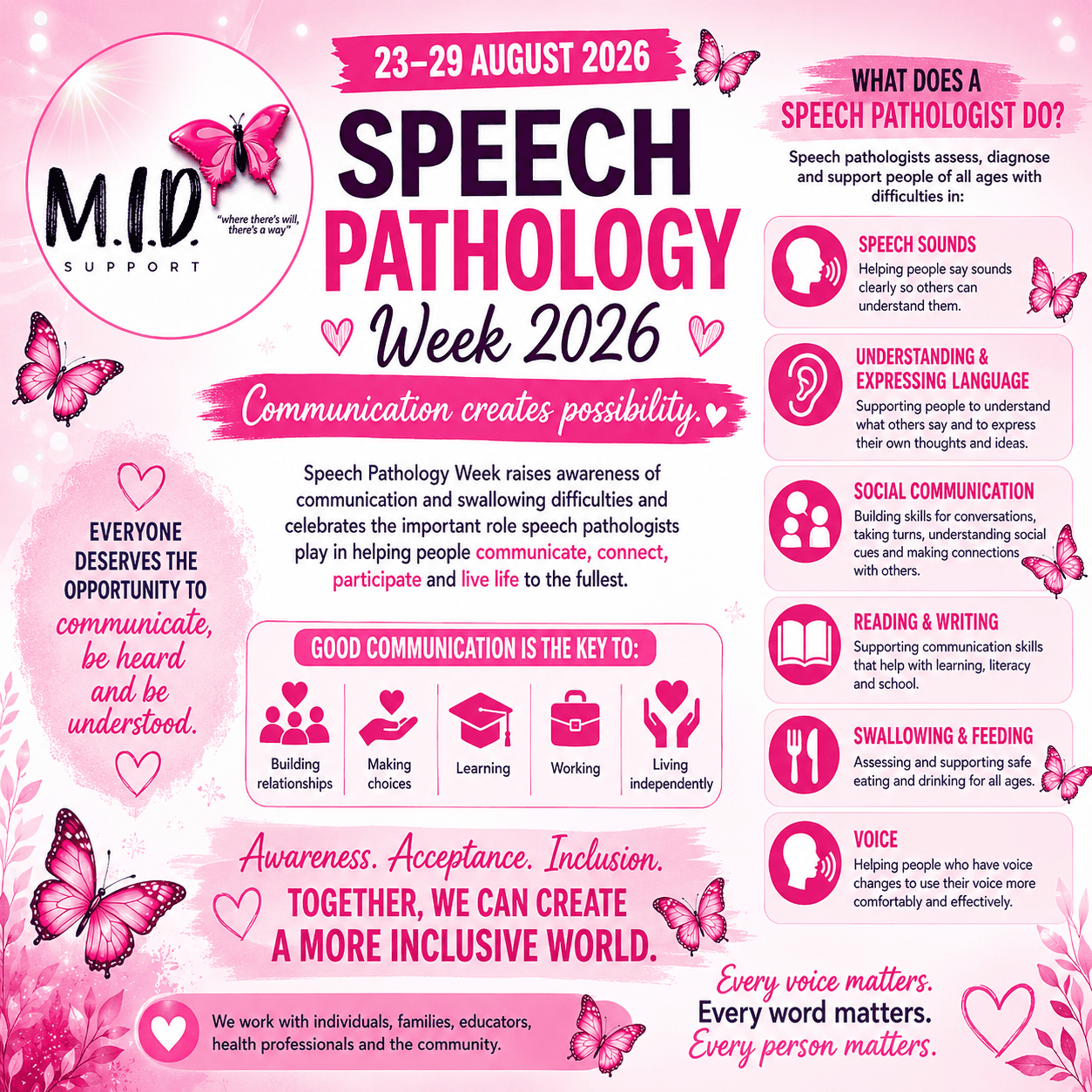
From 23–29 August 2026, communities across Australia recognise Speech Pathology Week 2026, an important opportunity to raise awareness about communication and the many ways speech pathologists support people throughout their lives.
This year’s theme, “Communication creates possibility,” highlights something that can easily be taken for granted: the ability to communicate can influence almost every part of everyday life.
Communication helps us express our needs, make choices, build relationships, learn, work, participate in our communities and develop greater independence.
At M.I.D. Support, we believe everyone deserves the opportunity to communicate, be heard, be understood and participate in their community in a way that works for them.
What Is Speech Pathology Week?
Speech Pathology Week is an annual awareness week highlighting the importance of communication and the role speech pathologists play in supporting people who experience communication or swallowing difficulties.
Communication is much broader than simply being able to speak clearly.
People communicate through speech, facial expressions, gestures, writing, pictures, signs, communication boards, technology and Augmentative and Alternative Communication (AAC).
There is no single correct way to communicate.
For some people, communication difficulties may be present from childhood. For others, they can develop later in life because of disability, illness, injury or changes associated with ageing.
Speech pathologists can work with people of different ages, abilities and communication needs.
What Does a Speech Pathologist Do?
A speech pathologist is a qualified health professional who assesses and supports people experiencing difficulties with communication and swallowing.
Their work can cover many different areas.
Speech and Speech Sounds
Some people experience difficulty producing particular sounds or speaking clearly enough for others to understand them.
Speech pathologists can assess these difficulties and develop strategies or therapy approaches to support clearer and more effective communication.
The goal isn’t necessarily for everybody to communicate in exactly the same way. Support should focus on the person’s individual communication needs and goals.
Understanding and Expressing Language
Communication involves both understanding language and expressing ourselves.
A person may find it difficult to understand questions, instructions or conversations. Others may know what they want to communicate but have difficulty finding words, forming sentences or expressing their thoughts and needs.
Speech pathology can support people to strengthen these skills and explore communication strategies that work for them.
Social Communication
Communication also plays an important role in relationships and social participation.
Speech pathologists may support skills associated with conversations, taking turns, interpreting social information, expressing emotions and communicating with others in different environments.
The appropriate approach will depend on the individual. Communication support should respect each person’s preferences, identity and natural communication style.
Reading, Writing and Literacy
Speech pathology can also have an important role in literacy and learning.
Language skills are closely connected with reading, writing and understanding information.
Depending on a person’s needs, a speech pathologist may provide support with areas such as reading comprehension, written language, vocabulary and other communication skills associated with learning.
These skills can support participation at school, work and throughout everyday life.
Eating, Drinking and Swallowing
Speech pathologists don’t only work with communication.
They can also assess and support people experiencing eating, drinking and swallowing difficulties, sometimes referred to as dysphagia.
Swallowing difficulties can affect people of different ages and may require professional assessment and individualised recommendations.
Where swallowing safety is a concern, advice should always come from appropriately qualified health professionals who understand the person’s individual circumstances.
Voice
Our voice is another important part of communication.
Some people experience changes to the quality, strength, comfort or effectiveness of their voice.
Speech pathologists may assess voice difficulties and provide appropriate strategies or therapy to help a person use their voice more comfortably and effectively.
AAC and Different Ways to Communicate
One particularly important part of communication support is recognising that speech is not the only way people communicate.
Augmentative and Alternative Communication, commonly known as AAC, includes methods and tools that supplement or provide alternatives to spoken communication.
AAC can include communication boards, pictures, symbols, signs, written communication, specialised devices and communication apps.
For the right person, AAC can provide greater opportunities to express preferences, communicate needs, make decisions and participate more independently.
AAC isn’t about taking someone’s voice away. It can provide another way for that person’s voice to be heard.
Communication and Disability Support
For people living with disability, having access to appropriate communication support can make a meaningful difference to everyday participation.
Effective communication can help people:
- Build and maintain relationships
- Express their choices and preferences
- Participate in education and learning
- Communicate their needs
- Engage in employment and activities
- Develop greater independence
- Participate in social and community settings
- Advocate for themselves and their rights
For some eligible participants, speech pathology and communication-related supports may form part of their NDIS-funded supports, depending on their individual goals, disability-related needs, plan and current NDIS funding arrangements.
NDIS participants should always check their individual plan and seek appropriate advice about what supports can be funded.
Communication Creates Possibility
The theme for Speech Pathology Week 2026 – “Communication creates possibility” – is a powerful reminder of why accessible communication matters.
Being able to communicate can create opportunities to make decisions, develop friendships, participate in the community, learn new skills and have greater control over everyday life.
It is also important that families, carers, support workers, educators, health professionals and the wider community give people the time, opportunity and appropriate support to communicate.
Sometimes inclusion begins with something as simple as slowing down, listening and allowing someone enough time to express themselves.
Celebrating Speech Pathology Week 2026
This Speech Pathology Week, we recognise speech pathologists and the important work they do alongside individuals, families, carers, educators, disability support providers and other health professionals.
We also celebrate the many different ways people communicate.
Communication doesn’t look the same for everyone — and it doesn’t need to.
At M.I.D. Support, we are committed to promoting inclusion, choice, participation and opportunities for people with disability within our community.
Every voice matters. Every word matters. Every person matters.
Together, we can continue building communities where people are given the opportunity and support to communicate, connect, participate and be understood.
Awareness • Acceptance • Inclusion